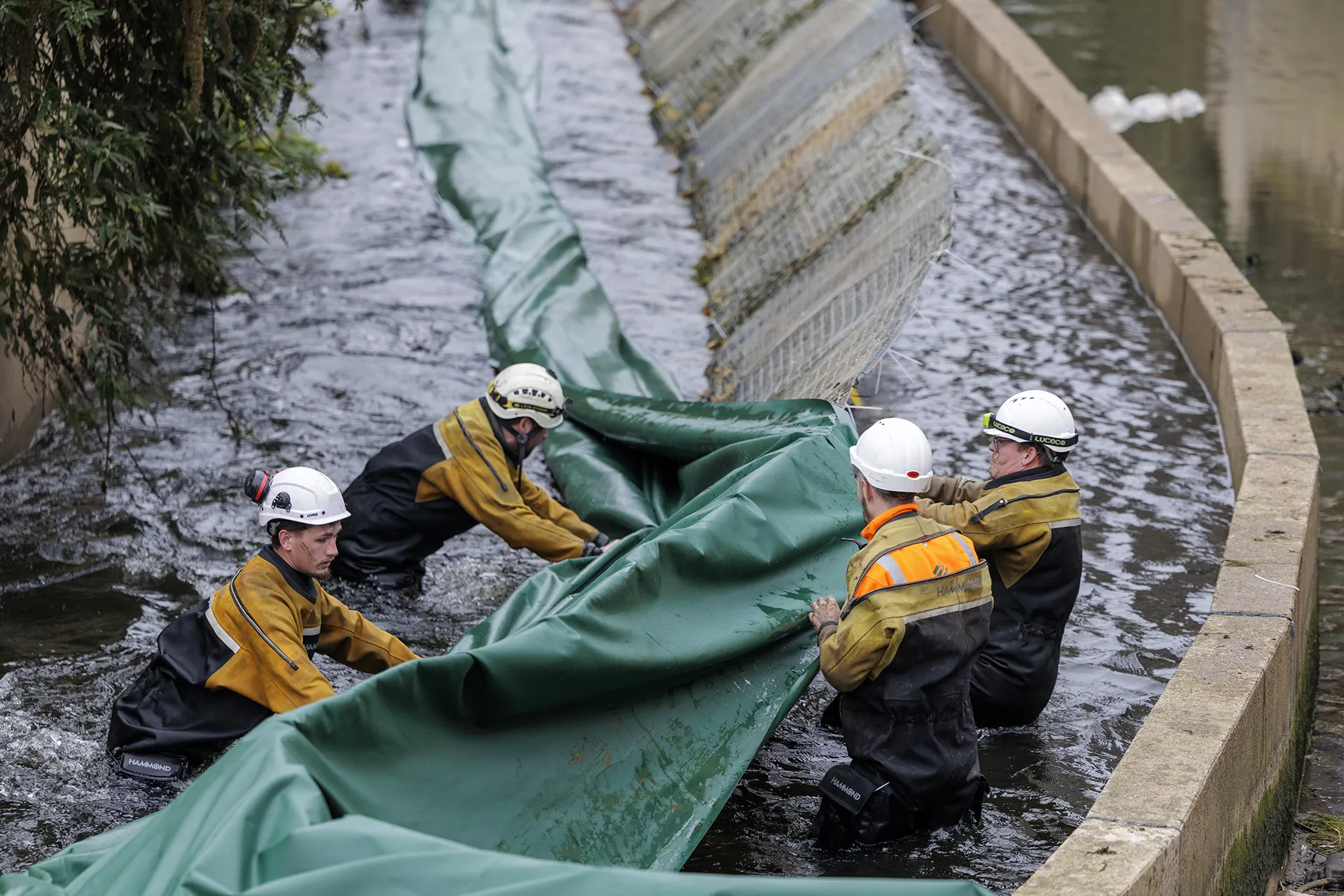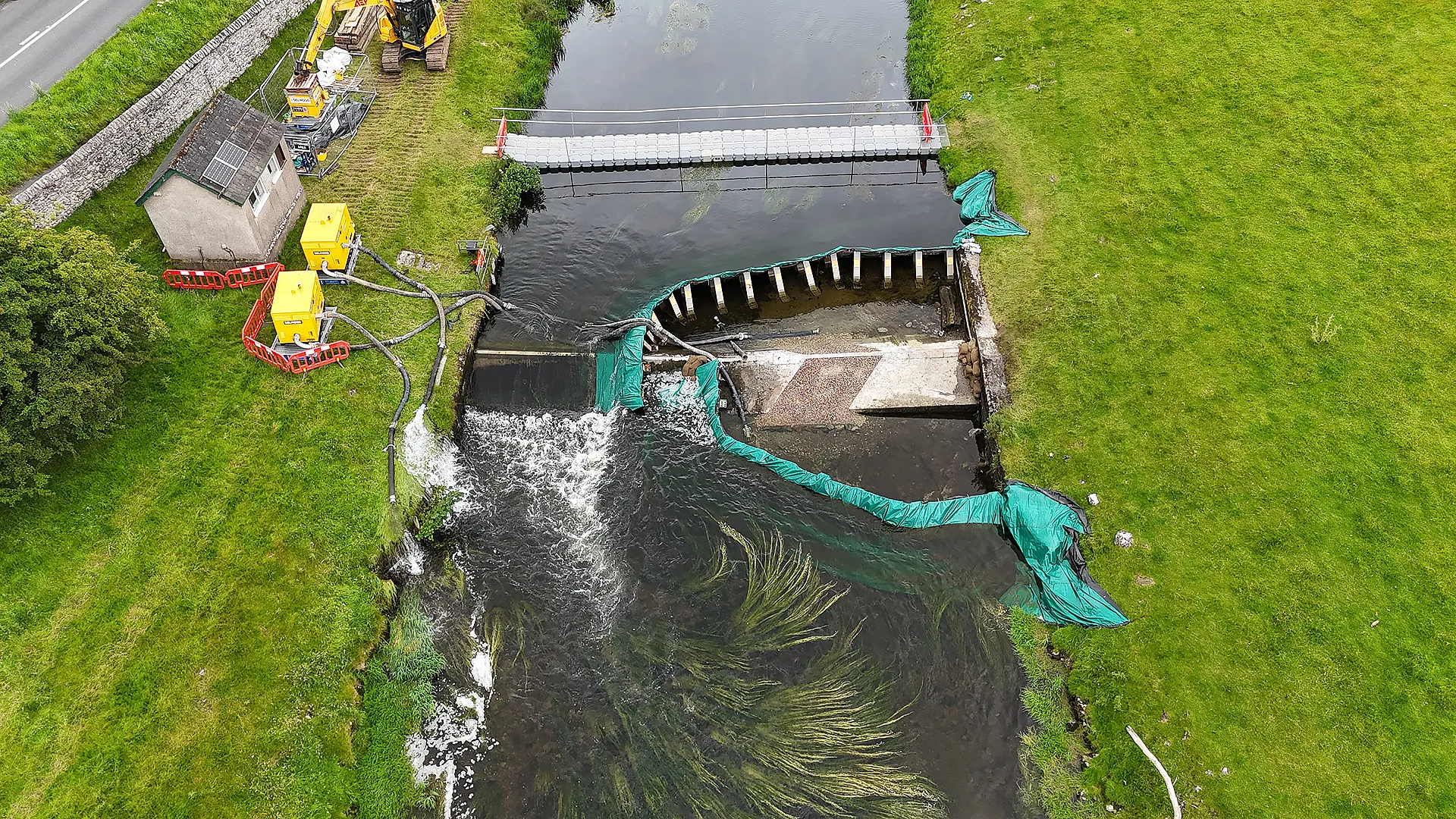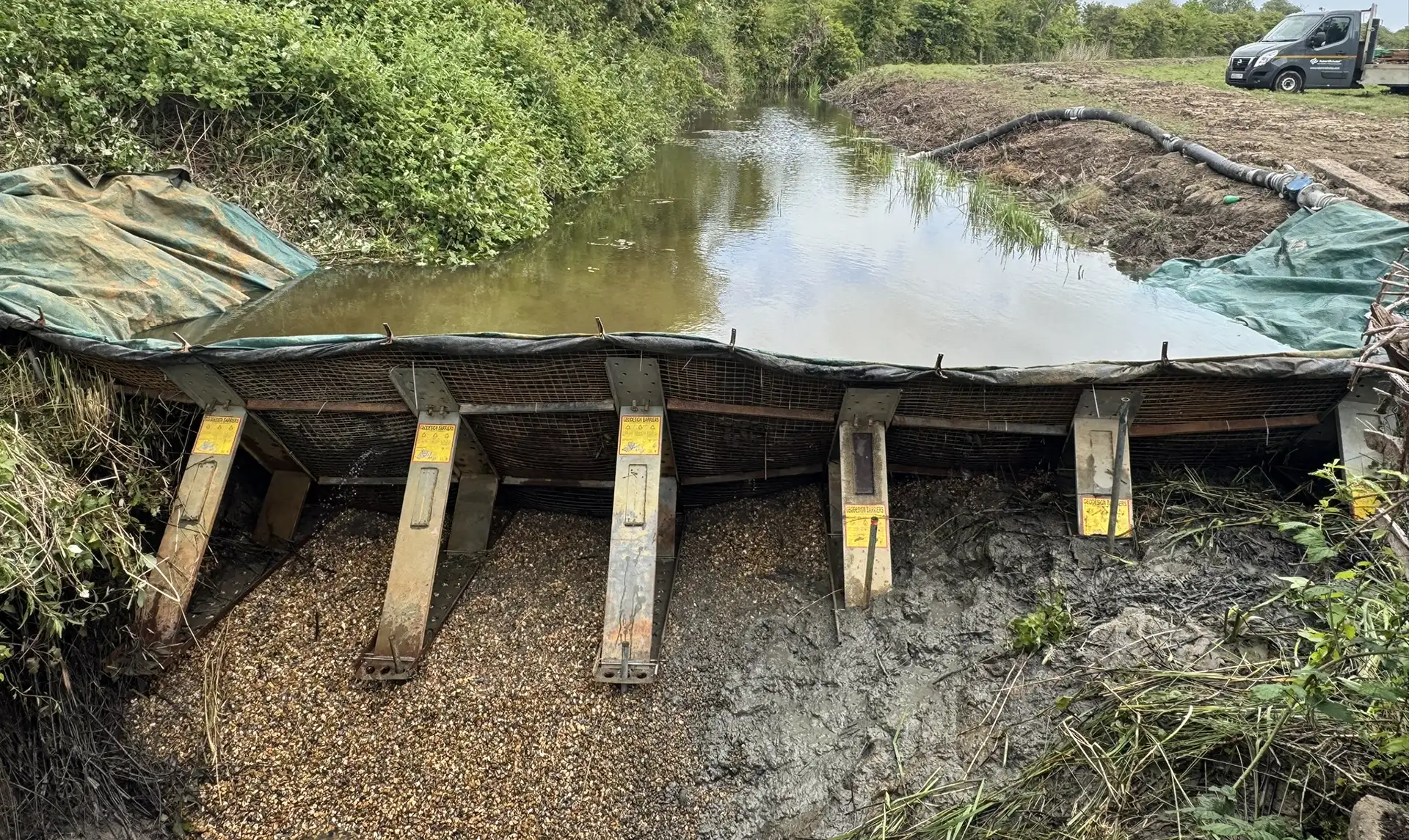
Frame dams are used in both construction and flood defence. They can take many forms, from proprietary systems such as Geodesign, PortaDam and Inero barriers to fabric-covered frames assembled from scaffold tube and fittings.
The details vary, but the underlying principle is broadly similar.
What is a frame dam?
A frame dam is a temporary water-retaining barrier made from repeated structural frames supporting an impermeable membrane.
Unlike a vertical wall, the retaining face is normally inclined back towards the dry or dewatered side. A useful way to picture it is to compare a vertical river wall with a steeply sloping riverbank.
A vertical wall has to resist the horizontal force of the water directly. A sloping bank redirects some of that force into the ground beneath it. A frame dam behaves in a similar way.
As water pressure acts against the inclined face, the supporting frame transfers that load into reactions at the ground. Part of that reaction acts horizontally and part acts downwards. That downward force is important because it increases the force between the barrier and the surface beneath it.
In simple terms, the geometry of the frame helps turn water pressure into stability.
Think of a paddling pool
Anyone who has tried to move a half-full children’s paddling pool will understand one part of the principle. An empty paddling pool is easy to drag around. Add water and it becomes surprisingly difficult to move. That is partly because of the weight of the water, but also because the water presses the flexible floor of the pool firmly against the ground.
The greater the force pressing two surfaces together, the more friction can potentially be developed between them.
A frame dam uses a similar effect. The waterproof membrane normally extends some distance along the bed or ground in front of the barrier, with retained water sitting directly above it. The water therefore pushes the membrane down against the surface beneath.
That downward pressure can increase the normal force between the membrane and the ground and, where the interface has sufficient friction, increase resistance to sliding. Again, the dam is using the water it is holding back as part of the mechanism that helps keep it in place.
The membrane does more than keep the water in
The membrane is one of the most important parts of a frame dam. Its obvious job is waterproofing, but it also helps the barrier form a seal against the surface below.
A useful comparison is a thin carrier bag or bin liner filled with water. Place it on an uneven surface and the water inside pushes the flexible material closely into the shape beneath it. The membrane follows small bumps and hollows almost like shrink-wrap.
The same principle operates at the base of a frame dam.
Before the full hydrostatic load develops, the leading edge of the membrane normally needs to be held in contact with the bed. This is often achieved using a weighted chain, ballast bags or a similar continuous load along the front edge.
That initial restraint allows the seal to start forming. As the retained water rises over the membrane, hydrostatic pressure then pushes a progressively larger area of fabric down onto the riverbed, canal bed, concrete slab or other surface beneath it.
In effect, the weighted leading edge starts the seal and the water pressure develops it.
Once loaded, the flexible membrane can conform to irregularities far better than a rigid plate usually could, helping to reduce the pathways through which water can pass beneath the barrier.
There is, however, a balance. A very flexible membrane may conform extremely well, but it must still be strong enough for the conditions in which it is being used. A carrier bag might mould beautifully around the ground, but you would not choose the thinnest one you could find to hold a tonne of water.
The membrane therefore has to combine flexibility with sufficient strength and durability.
Supported and unsupported membranes
Not all frame dams support their membranes in the same way.
Some systems use panels or closely spaced structural elements behind the waterproof layer, providing a relatively continuous supporting face. Others rely on the membrane itself spanning between individual frames.
That distinction matters.
Where a membrane is continuously supported, the panel or structural face carries much of the water load into the frames. Where the membrane spans between supports, the fabric itself becomes part of the structure.
The water causes it to bulge between the frames, creating tension in the membrane. Those forces then have to be transferred into seams, welds, reinforced edges and the points at which the membrane is attached to the supporting structure.
So in some systems the membrane is principally providing waterproofing and sealing. In others it is also a significant load-bearing component.
The ground is part of the system
Frame dams are often described as though the barrier itself is the whole structure. It is not.
Every load acting on the dam eventually has to be transferred somewhere, and in most cases that means into the ground. The interaction between the frame and the surface beneath it is therefore fundamental.
A dam installed on smooth concrete will behave differently from the same dam installed on clay. Clay behaves differently from gravel. Gravel behaves differently from large angular stone.
Even the same frame system can therefore rely on different resistance mechanisms from one site to another.
On a hard surface, friction between the barrier and the ground may be particularly important. On softer ground, individual frame supports may penetrate into the bed and begin to interact with the soil below the surface. On coarse angular ground, supports may physically lodge against stone and develop resistance through local bearing or mechanical interlock.
Some systems also use pins, anchors or other forms of additional restraint where the surface conditions demand it.
This is one of the reasons frame dams are so adaptable. It is also why understanding the site is just as important as understanding the product.
Construction and flood defence
In construction, frame dams are commonly used to create temporary dry or controlled working areas within rivers, canals, reservoirs, treatment works and other water-retaining assets. Their modular nature can make them particularly useful where sheet piling, earth bunds or other forms of isolation would cause excessive disturbance or simply cannot be installed.
The barrier can often be installed directly in the water, after which the isolated area is pumped down to create access for the permanent works. The temporary dam therefore becomes part of a wider water-management system rather than simply a barrier.
The same basic engineering principle can also be used for temporary flood protection. Here, the barrier may be installed on dry ground in advance of a flood event. As the floodwater rises, pressure builds against the membrane and frame and the same mechanisms of load transfer, downward reaction and membrane pressure begin to operate.
The physical behaviour may be similar, but the operational problem is different. Flood barriers may need to be stored for long periods, transported rapidly, deployed over large distances and installed before the water arrives, often across roads, verges and irregular ground.
Simple principle, complicated reality
The appeal of a frame dam is easy to understand. It is modular, comparatively lightweight and can often be installed with relatively little permanent disturbance. Most importantly, it uses the force of the retained water to help generate the reactions that keep it stable.
But that apparent simplicity can be misleading. The behaviour of the membrane, the shape of the frame, the surface beneath it and the way the load reaches the ground are all part of the same system. Change one of them and the way the barrier behaves can change too.
That does not make frame dams unreliable. It makes them engineering structures.
So how does a frame dam work?
Water pushes against the membrane.
The membrane transfers that pressure into the supporting structure.
The frame redirects the load into the ground.
Water pressure on the membrane helps clamp the system onto the surface beneath it.
The ground provides the resistance needed to stop the dam moving.
Depending on the system and the site, that resistance may come from friction, bearing, ground engagement or additional anchorage.
The result is a temporary barrier that can use the water it is holding back as part of its own stability.
That is the clever part.
The more difficult question is how an engineer establishes how much of that stability can safely be relied upon on a particular site. That is something we will look at in the next article in this series.