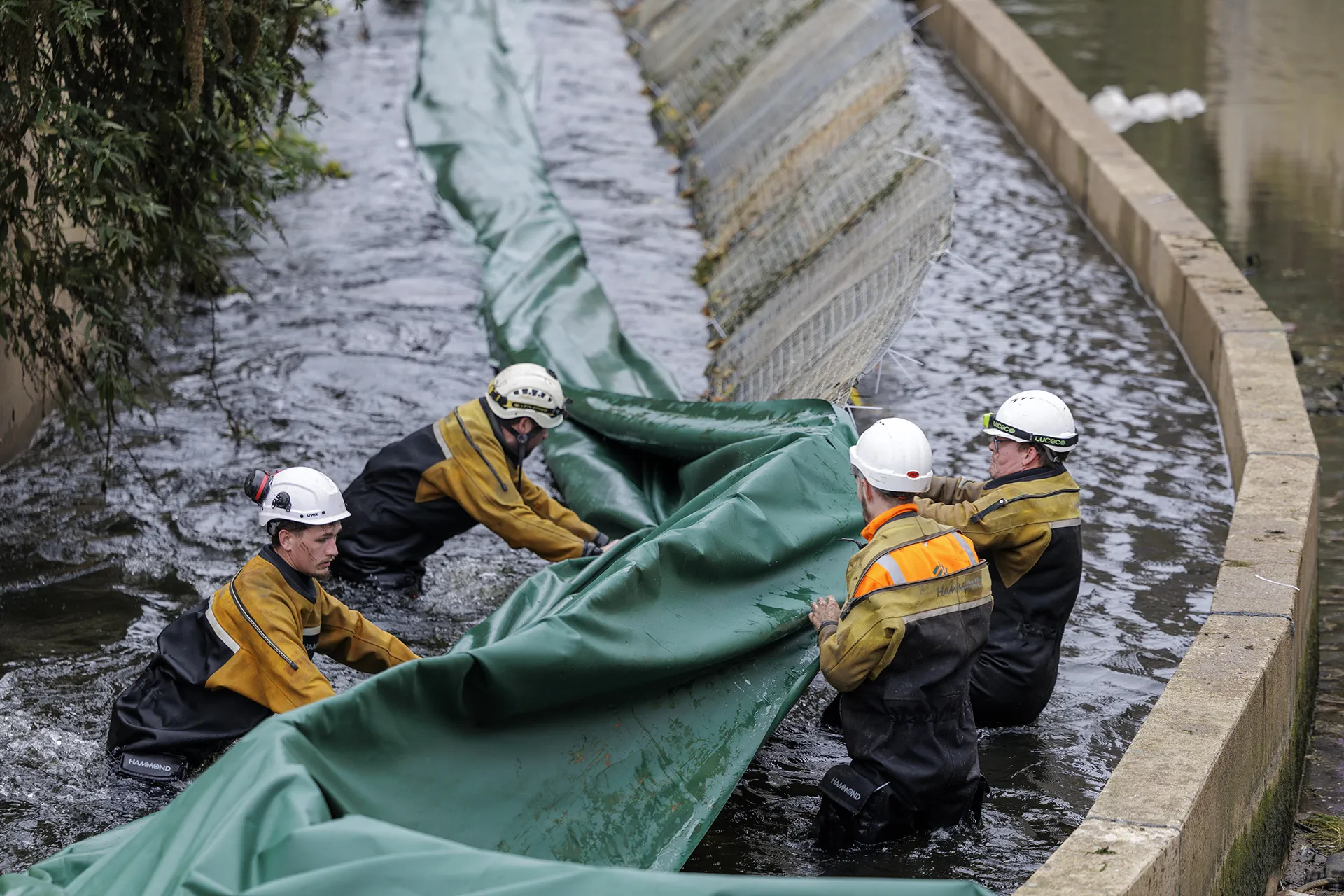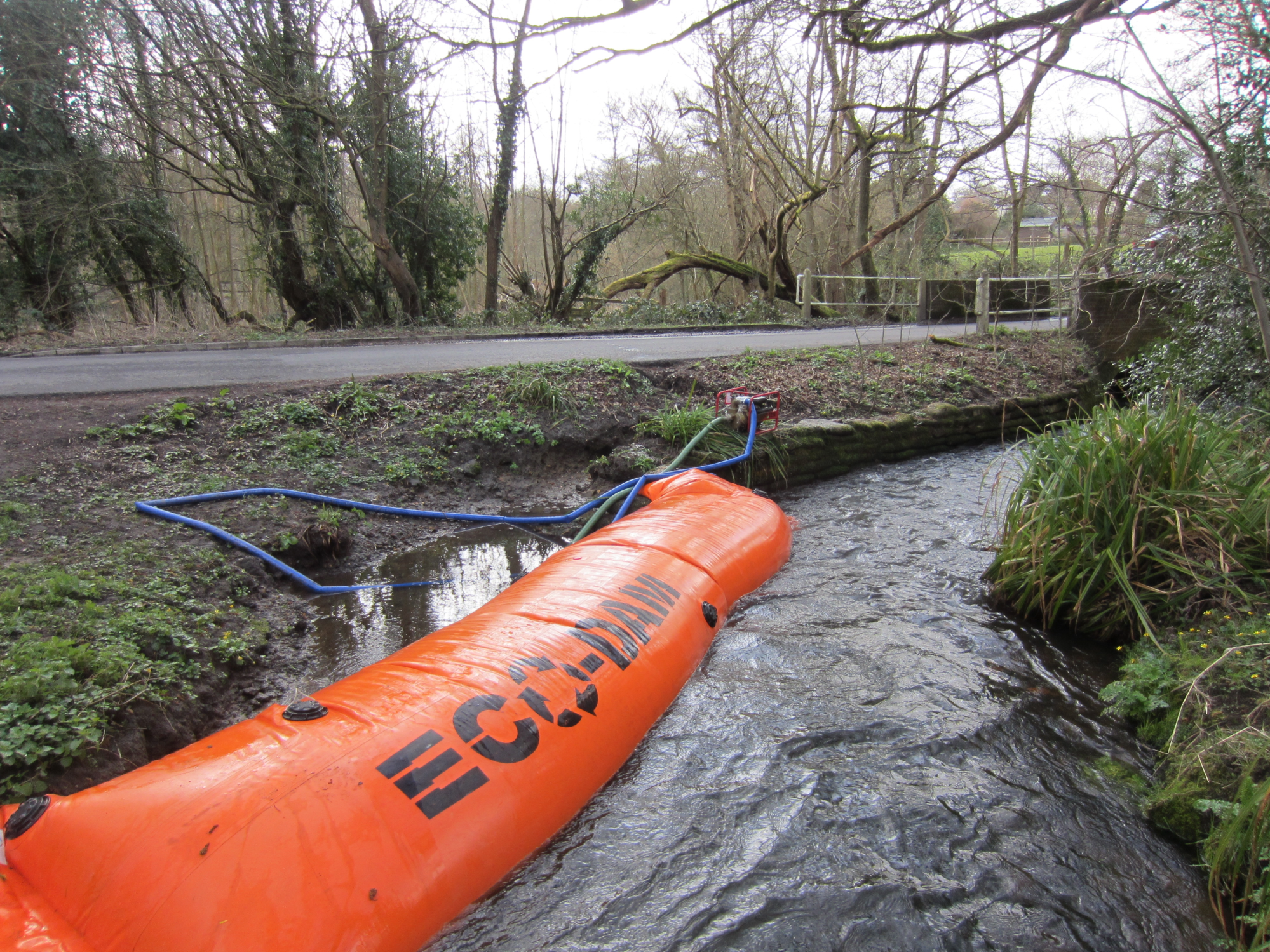
At first glance, a water-filled dam seems almost too simple to work. Take a large flexible tube, fill it with water, and use it to hold back the water on the other side.
The principle is straightforward. A relatively large mass of water, contained within a flexible structure, is used to resist the pressure from a lower height of water outside it. The weight of the contained water provides the ballast needed to keep the barrier in place.
It’s an elegant idea, and one that can work remarkably well.
At High Water, we’ve spent many years installing and working with water-filled dams, experiencing both their advantages and their limitations firsthand. We’ve seen them perform exceptionally well in difficult conditions, but we’ve also witnessed failures that demonstrate how quickly these apparently simple structures can become unstable.
That experience has fundamentally influenced how we approach temporary water control.
What is a water-filled dam?
A water-filled dam is a flexible barrier, typically manufactured from reinforced PVC, polyethylene or geotextile materials, which is inflated using water.
Unlike a conventional inflatable barrier, which contains air, a water-filled dam uses the weight of the water inside it to resist the pressure of the water outside.
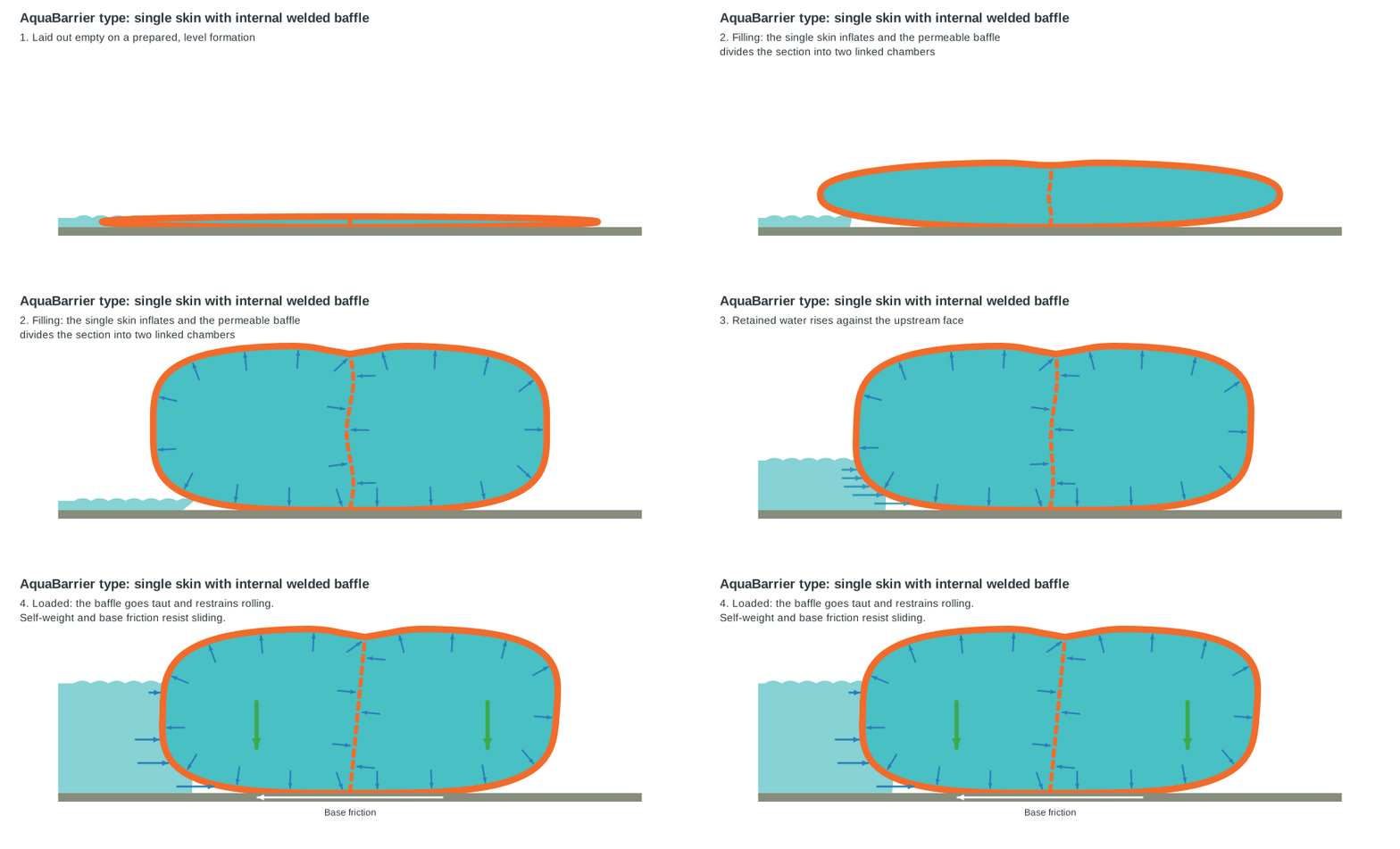
These systems come in various forms, including single outer tubes with internal baffles, twin water-filled tubes enclosed within a restraining sleeve, and arrangements of separate tubes secured together.
Examples include Aqua-Barrier, AquaDam and modular systems such as Tiger Dam. The construction methods differ, but the underlying principle is broadly similar: using contained water to provide the mass needed to resist external water pressure.
Water-filled dams are usually considerably wider than they are tall. Depending on the system, the inflated width may be around twice its height, while the maximum recommended water-retaining depth is generally considerably less than the inflated height.
For example, a water-filled dam 3.0m wide and standing 1.5 m high might be designed to retain approximately 1.0 m of water, although the permissible depth depends on the particular system and its installation conditions.
That difference in height is important, as we’ll come back to later.
Why doesn’t it roll away?
Imagine placing a large cylindrical balloon filled with water on the ground and then pushing against its side.
Without anything to maintain its shape, it would tend to deform or roll away.
Water-filled dams overcome this problem by controlling their cross-sectional geometry.
Some systems use internal fabric baffles which hold the tube in a broad, flattened shape. Others use two separate tubes, held alongside one another within a larger outer sleeve. Modular systems may use straps, anchorage or other restraints to maintain their arrangement.
The resulting shape is generally much wider than it is high, helping to resist rolling and providing a broad area of contact with the ground.
But there’s something important happening inside the structure.
Although the contained water provides the mass, the fabric and its connections are responsible for maintaining the shape. The water generates forces within the membrane, which must be resisted by the tensile strength of the material, its welded or stitched seams, and any internal restraints.
These are not simply waterproof bags. The fabric and its connections are structural components.
Different methods of construction create different internal load paths and potential failure mechanisms. Understanding those forces, and demonstrating that the materials and connections can resist them, is an important part of assessing a water-filled dam.
What actually keeps it in place?
The principal resistance to sliding in many water-filled dam systems comes from friction between the barrier and the surface beneath it.
The weight of the contained water pushes the flexible structure against the ground, generating a contact force. Provided the surface offers sufficient friction, that force can resist the horizontal pressure of the retained water.
In simple terms, the heavier the barrier and the better its contact with the ground, the greater the frictional resistance it may be able to develop.
This is also what makes water-filled dams effective at sealing against irregular surfaces.
The flexible membrane can mould itself around modest changes in the bed profile, pressing into hollows and around small obstructions. In favourable conditions, the weight of the contained water can produce a remarkably good seal.
However, that flexibility has limitations.
A rounded tube does not naturally fit tightly into a square corner or against an abrupt change in geometry. Voids can develop around structural tie-ins, while the presence of soft sediment, algae or other materials can significantly change the friction available beneath the barrier.
Unlike a frame dam, where the supporting structure may also develop resistance through ground engagement, local bearing or additional anchorage, an unanchored water-filled dam is particularly dependent on the contact conditions beneath it.
And that introduces one of the most difficult things to predict.
Unfortunately, riverbeds aren’t always what they seem
One of the more surprising characteristics of water-filled dams is their ability to displace soft sediment.
We’ve experienced this repeatedly during installations.
As a large water-filled dam is inflated, the increasing weight can force soft silt out from beneath the barrier. In some circumstances, this is extremely beneficial.
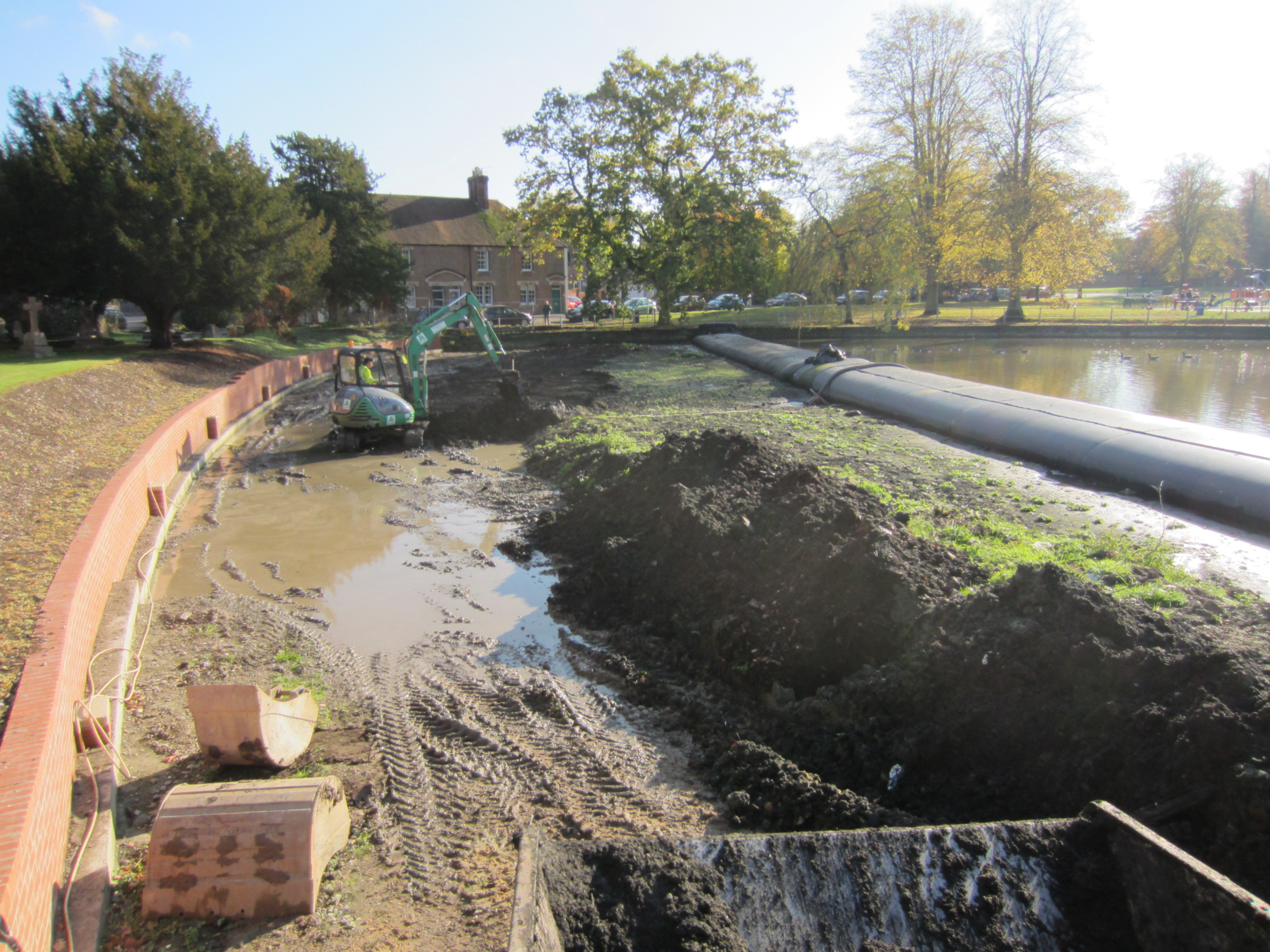
The barrier may sink through a layer of soft material and establish contact with firmer ground beneath it. The displaced sediment can also accumulate around the edges, helping to reduce seepage and producing a very effective seal.
We’ve seen this work exceptionally well.
The difficulty is knowing how much displacement will occur.
A bed survey may identify the upper surface of a layer of sediment without establishing the depth or strength of the material beneath it. As the barrier is filled, it may continue to sink further than anticipated.
This presents an interesting problem.
If a 1.5 m-high barrier has been selected to retain 1.0 m of water, but subsequently settles substantially into the sediment, its effective height above the surrounding bed is reduced.
The barrier may no longer have sufficient height to retain the intended water level, even though it has been installed and inflated correctly.
Soft sediment can also deform or move beneath the barrier, changing the available friction and potentially allowing it to slide.
So the very characteristic that makes water-filled dams effective at conforming to soft ground can also introduce considerable uncertainty into their performance.
What happens when the water rises?
Water-filled dams have another important characteristic: their stability can reduce as the external water level increases.
As the retained water rises, the horizontal hydrostatic force acting against the barrier increases.
At the same time, external water surrounding the barrier introduces buoyancy on the lower curvature of the wetted face, reducing the effective force pressing the dam against the ground and potentially reducing its frictional resistance.
This creates an unfavourable combination: increasing horizontal loading and diminishing resistance.
At sufficiently high external water levels, a water-filled barrier can approach neutral buoyancy. Its contained water no longer provides the same stabilising advantage against the surrounding water.
Depending on its construction and restraints, the barrier may then slide, deform, roll or become displaced.
This is why the difference between the inflated height of a water-filled dam and its specified maximum water-retaining depth is so important.
A barrier designed to retain 1.0 m of water is not necessarily capable of safely retaining 1.2 m simply because its inflated height is greater.
And, as we’ve already seen, unexpected settlement into soft sediment can reduce the margin even further.
What happens if the dam loses containment?
So far, we’ve considered what happens when the conditions around the dam change.
But what happens if the structure itself is damaged?
Unlike a rigid structural barrier, a water-filled dam relies on the integrity of its flexible containment system. Punctures, cuts, abrasion and vandalism can all result in a loss of contained water.
We’ve encountered deliberate damage to these systems on construction sites, including kids riding bikes across them, so this is far from a theoretical concern.
The internal construction also matters. In systems using welded baffles or seams, inadequate weld strength or failure of a connection can cause a sudden change in geometry. A significant rupture may result in rapid loss of water and stability.
The consequences depend on the particular construction. Some systems have separate containment chambers or external restraints which may provide a degree of redundancy. Others are vulnerable to a single failure affecting a substantial part of the barrier.
The important distinction is that some water-filled dam failures can occur very rapidly, with little warning.
For construction works, the consequences can be particularly serious.
If a large barrier loses stability, the retained water can enter the working area suddenly. The flexible dam itself may also be carried into the excavation or work area, creating additional hazards of impact, entanglement and entrapment.
It is not simply a question of whether the barrier leaks. It is whether people working behind it can remain safe if the system fails.
Where do water-filled dams work well?
Despite these limitations, water-filled dams remain a useful method of temporary water control.
Their lightweight construction makes them comparatively easy to transport, and they can often be deployed without substantial lifting equipment. They can be particularly effective for shallow-water isolation, temporary containment, flood protection and spill management.
For emergency flood deployment, where barriers may need to be transported and installed quickly on otherwise dry ground, the advantages can be considerable.
But there is an important distinction between protecting an area from flooding and creating a safe working environment for construction personnel.
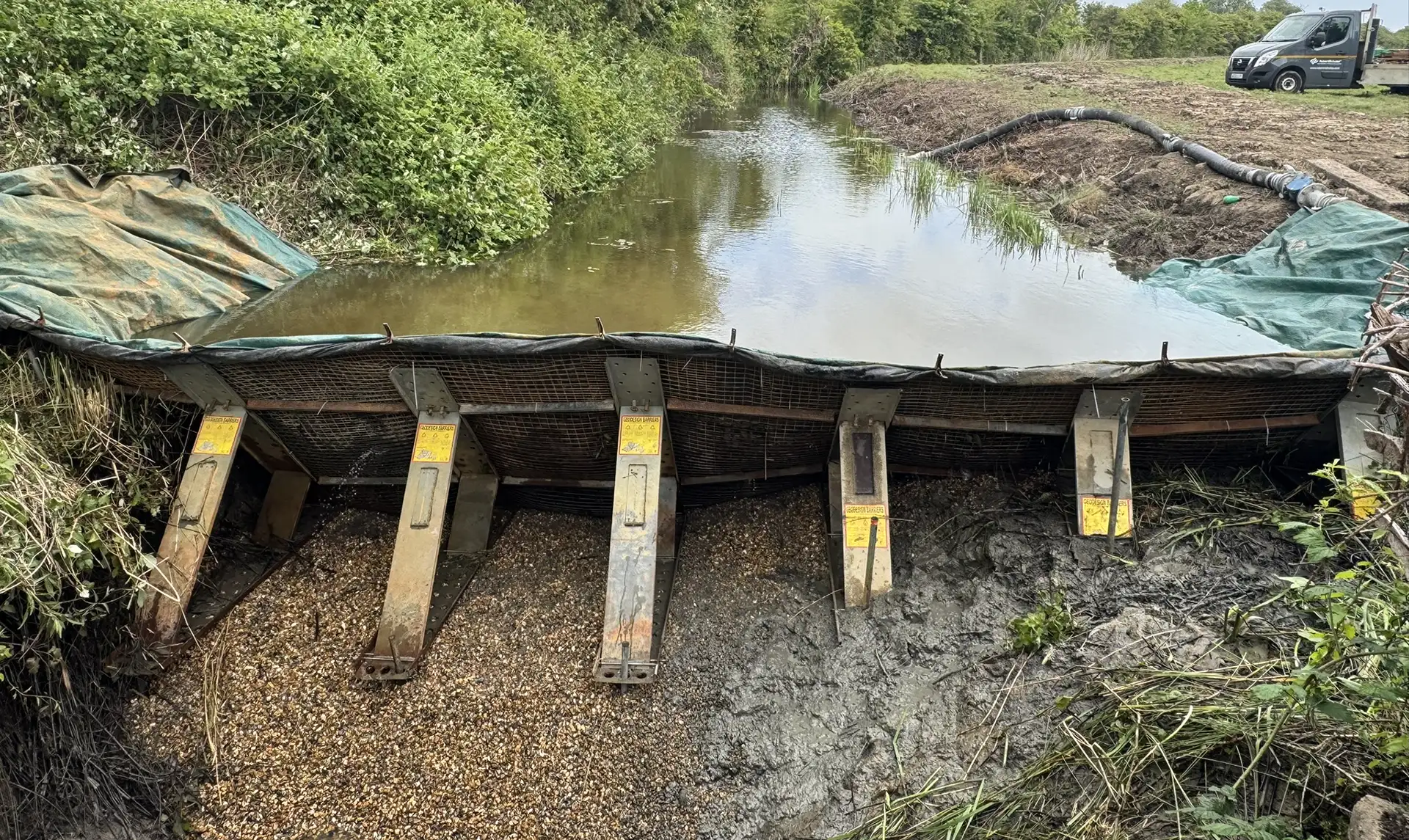
At High Water, our experience has led us to favour properly designed frame dams and other more predictable structural systems for construction isolation.
We no longer use large water-filled dams for construction temporary works. We rarely consider water-filled barriers for retained depths greater than 0.5 m, and we will not deploy them where sudden failure could place personnel at risk.
That is our own risk-based approach, developed from experience, rather than a universal limit on the performance of water-filled barriers.
We recognise that these systems have valuable applications, particularly for smaller-scale, lower-consequence water control and emergency protection. What matters is understanding where their advantages can be used without introducing unacceptable risk.
So how does a water-filled dam work?
- A large volume of water is contained within a flexible structure.
- The fabric and its restraints maintain the shape of that structure.
- The weight of the contained water creates contact pressure against the ground.
- Friction between the barrier and the ground provides resistance against the pressure of the retained water.
- The flexible membrane conforms to the surface beneath it, helping to create a seal.
It’s a wonderfully simple principle.
But the stability of the barrier ultimately depends on the integrity of the containment, its geometry, the supporting ground and the conditions under which it operates.
The difficult question is not simply whether a water-filled dam can hold back water. It is whether its performance can be relied upon throughout the period it is required to operate.
And, particularly where people are working behind it, that is a much more important question.