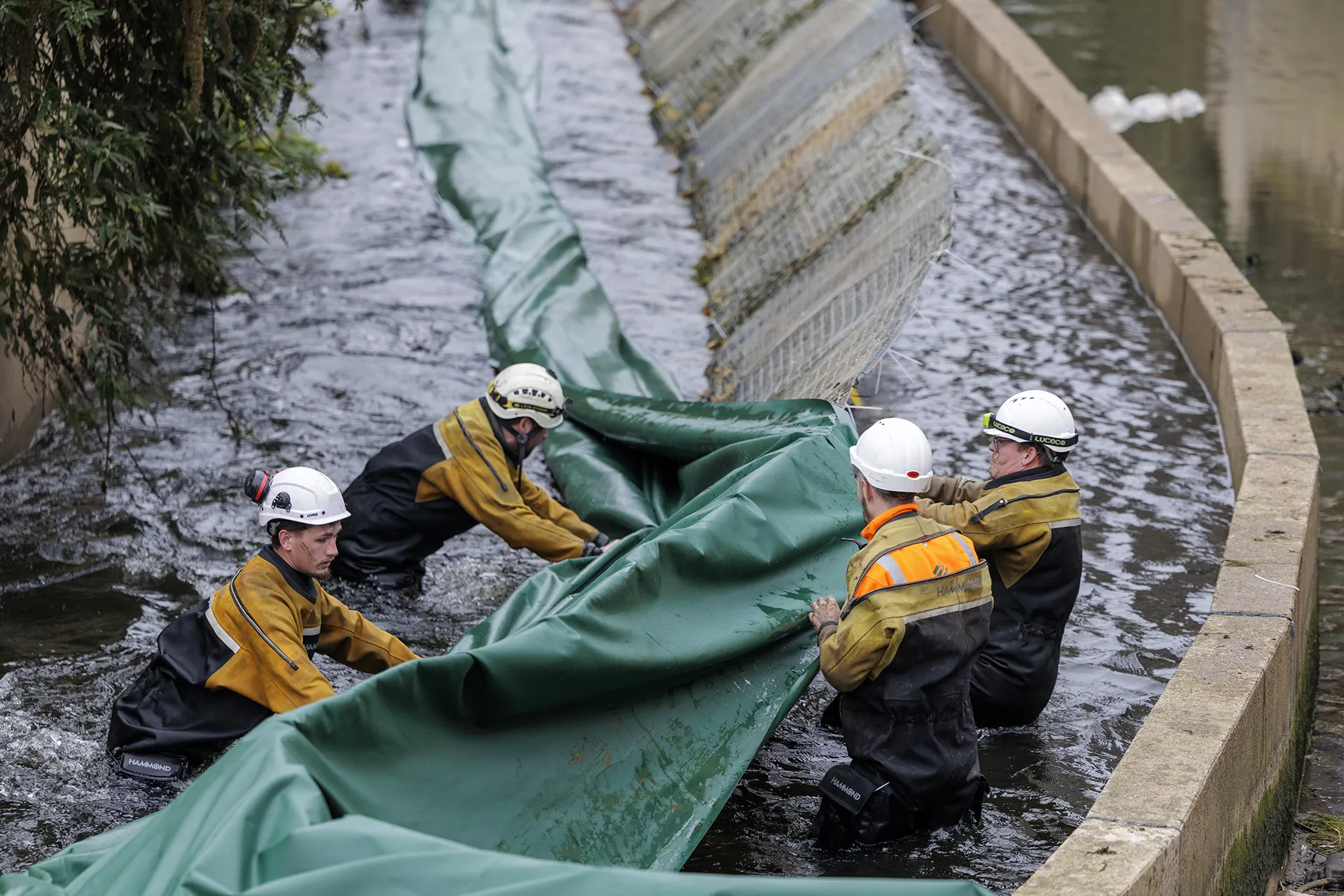
Much of the infrastructure that our communities rely on sits in, alongside or beneath water.
Bridges and culverts cross rivers. Outfalls and intakes connect treatment works to watercourses. Locks, sluices and weirs control navigation and water levels. Harbour walls, docks and marine structures are built directly into the water. Much of this infrastructure is also old, in some cases dating back a century or more, and needs to be inspected, maintained, repaired or replaced.
The problem is simple: construction is much easier in the dry.
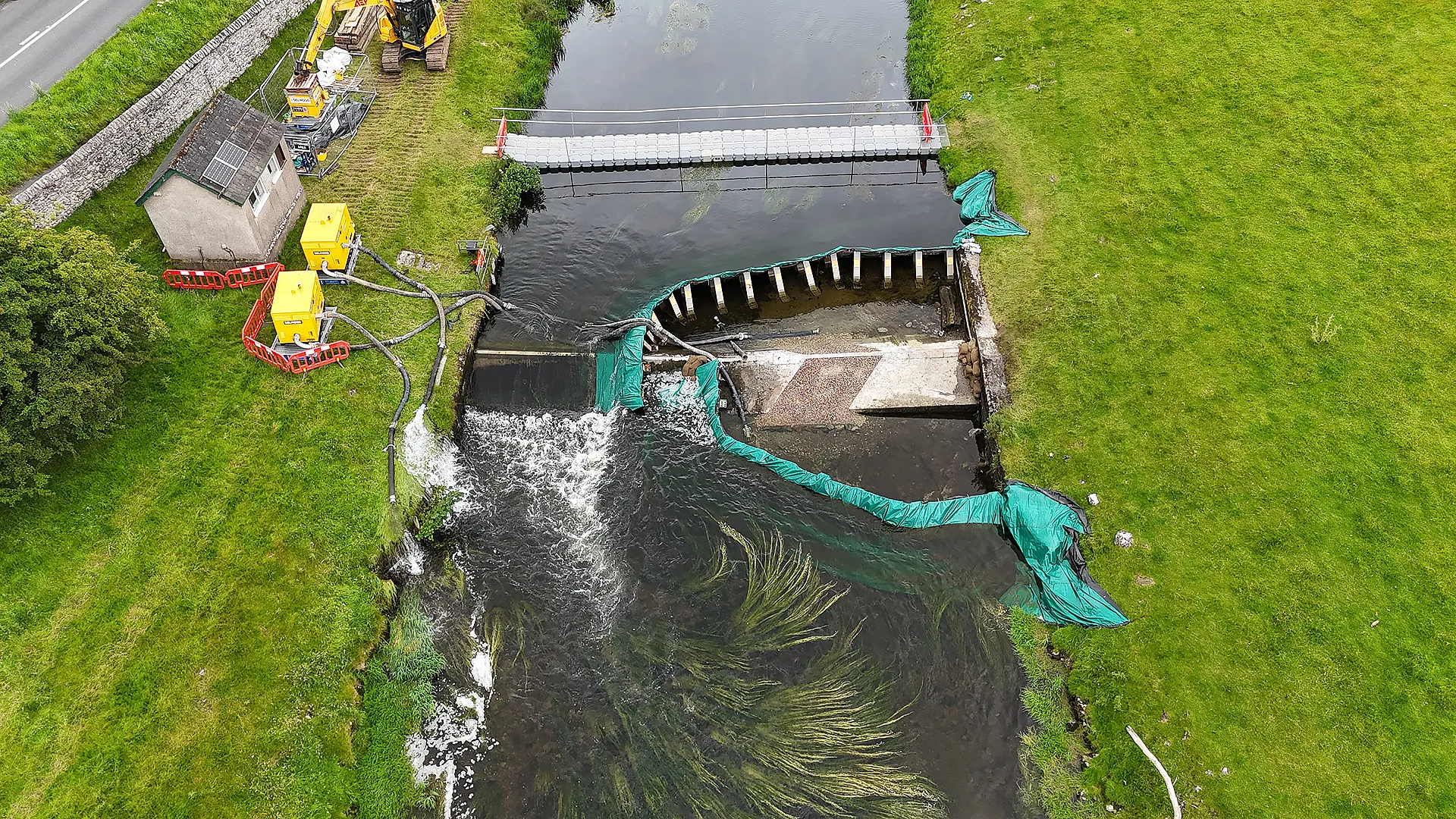
A temporary dam creates a controlled working area by temporarily holding water back or excluding it from part of a watercourse, structure or asset. This allows work that would otherwise need to take place underwater, or from the water, to be undertaken using more conventional construction methods.
But the temporary dam is rarely the objective in itself. It is an enabler: a temporary works solution that allows the permanent works to be delivered.
Why do we need temporary dams?
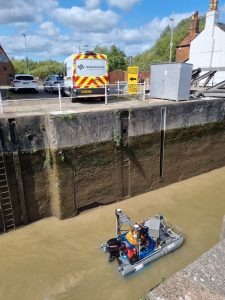
Working underwater is possible, and sometimes it is the right solution. Commercial divers undertake complex inspection, maintenance and construction activities every day.
But underwater working introduces significant limitations. Visibility can be poor, access is restricted, tools and methods need to be adapted, and inspection and quality assurance are more difficult. Tasks that are relatively straightforward in the dry can become slow and highly specialised underwater.
Creating dry access changes that. It allows people to see the asset they are working on, provides easier access and egress, and allows conventional plant, tools and construction techniques to be used. Excavation, concrete repair, reinforcement, drilling, fixing, inspection and coating can all be undertaken in a more controlled environment.
There is an economic argument too. Being able to construct or repair something to the same standard expected above the waterline provides greater certainty over quality and whole-life performance. The cheapest way of gaining access to an asset is not necessarily the cheapest way of maintaining it over its lifetime.
How we create that access has also changed.
Historically, major civil engineering projects could justify enormous bespoke cofferdams and the isolation of substantial areas of a river, estuary or harbour. Temporary dams themselves are nothing new: engineers have been temporarily excluding water from construction sites for centuries.
Today, we are often maintaining ageing infrastructure while keeping the services it provides operational. Rivers still need to flow. Navigation may need to continue. Treatment works cannot simply be switched off. Space is often constrained. At the same time, expectations around worker safety and environmental protection are, quite rightly, much higher.
The challenge is increasingly to isolate only as much water as necessary, for only as long as necessary, while allowing everything around the worksite to continue functioning.
Creating a safer place to work
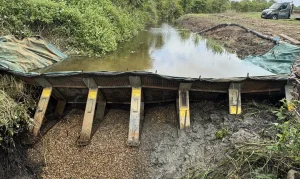
Working in and around water introduces hazards that do not exist on a conventional dry construction site. Moving water, poor visibility, restricted access, unstable footing and difficult emergency escape can all complicate otherwise routine activities. Working underwater adds another layer of specialist equipment, procedures and risk.
A temporary dam can remove many of those constraints by separating people and construction activities from the water. Teams gain visibility of the area they are working in, ready access into and out of it, and the ability to use conventional plant and equipment. Inspection, supervision and quality control also become easier.
Temporary dams do not eliminate risk. They change it.
A structure retaining water is subject to significant forces. Its stability can be affected by water depth, flow, ground conditions, changing water levels, seepage, scour, site geometry and its interaction with existing structures. Installation and removal can also be among the highest-risk stages because they often take place in or immediately adjacent to the water.
A temporary dam therefore needs to be considered as temporary works: designed, installed, monitored and removed with the same seriousness applied to other engineered structures.
And if the work can reasonably be undertaken without putting a temporary dam into the water at all, that option should always be considered.
Containing the environmental impact
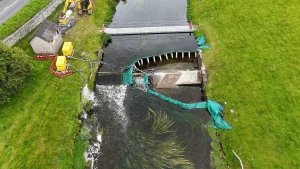
The same principle applies environmentally.
A well-considered temporary dam does not necessarily stop a river or isolate an entire body of water. It can contain a relatively small working area while allowing the wider watercourse to continue functioning.
Depending on the site, that can mean maintaining downstream flow, providing for fish passage, retaining navigation or simply reducing the extent and duration of disturbance.
It can also make ordinary construction activities much easier to control. Excavation is a good example. On a dry site, disturbed soil generally stays close to where it was excavated. In a flowing watercourse, fine material can immediately become suspended and create a silt plume that travels far beyond the working area.
Concrete works, cutting, drilling, demolition and construction chemicals can create similar problems if they are not properly contained.
By isolating the working area, a temporary dam can provide a controlled space in which sediment, construction water and potential contaminants can be managed before they enter the wider environment.
The dam itself is not the environmental solution. It creates the conditions in which good environmental management becomes possible.
So, what does a temporary dam look like?
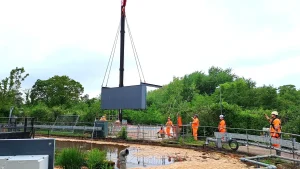
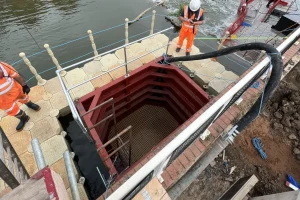
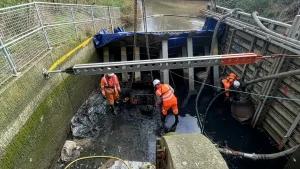
There is no single answer.
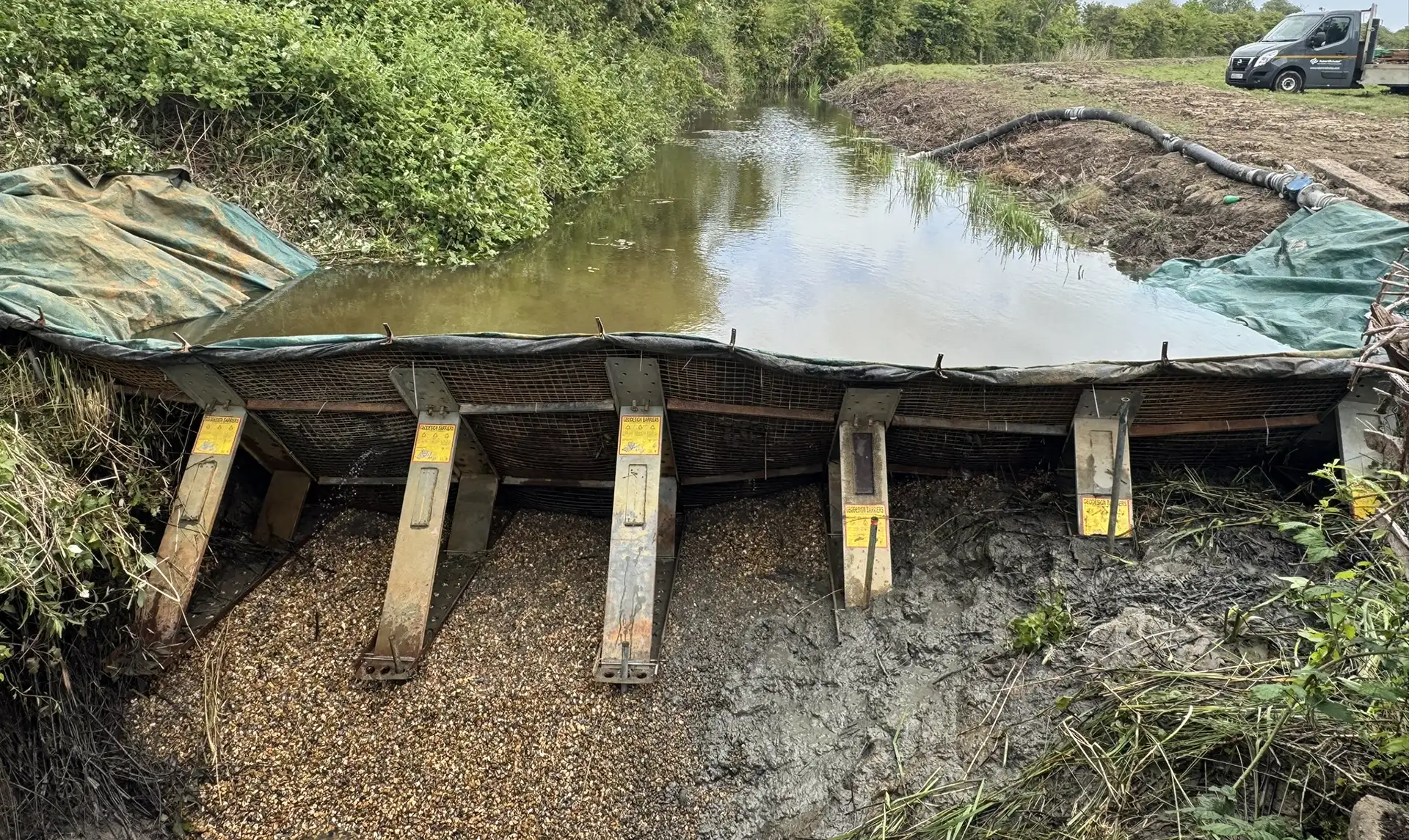
Temporary dams range from simple arrangements using sandbags or bulk bags, through water-filled tubes and proprietary barrier systems, to sheet piles and substantial bespoke cofferdams.
Some are embedded into the ground. Sheet-piled cofferdams, for example, develop their stability partly through their mechanical interaction with the ground into which they are installed.
Others are surface mounted. They sit on the existing bed, slab or structure without a substantial mechanical key into the ground and resist the forces imposed upon them through combinations of geometry, self-weight, friction, anchorage, membrane restraint or other mechanisms.
That distinction matters.
Modern proprietary systems have made temporary water control faster, more reusable and practical in locations where traditional cofferdam construction would be disproportionate. But this has also contributed to one of the biggest misconceptions about temporary dams.
The product may be standard. The application isn’t.
Historically, nobody would have regarded a major cofferdam built for a bridge pier or harbour development as simply a product. It was obviously a temporary structure designed for a particular location and a particular set of loads.
As temporary dam systems have become increasingly modular, reusable and productised, that distinction has become less obvious. It can be tempting to select a system based on a manufacturer’s stated maximum water depth or a standard installation diagram.
But water depth is only one part of the problem.
Flow, bed material, ground profile, existing structures, available footprint, differential head, seepage, scour, changing water levels, access, installation methodology and the consequences of failure can all vary from one site to another.
This is particularly important for surface-mounted systems because their performance depends upon the interaction between the system and the environment in which it is placed.
The manufactured components may be identical from one project to the next. The engineering conditions never are.
That is why we believe every temporary dam should be treated as a site-specific temporary works design, irrespective of whether the physical system itself comes from a standard product range.
Start with the problem, not the product
The first question should not be: “Which temporary dam should we use?”
It should be: “What are we trying to achieve, and what conditions do we need to manage to achieve it safely?”
Sometimes the answer will be a substantial embedded cofferdam. Sometimes it will be a lightweight reusable surface-mounted system. Sometimes it may be sandbags, bulk bags or another simple solution.
And sometimes the right answer is not to use a temporary dam at all.
Understanding that distinction is the starting point for good temporary works engineering.
Over this How It Works series, we’ll look in more detail at the different types of temporary dam, how they resist water, the conditions that influence their performance, how they should be designed and managed, and where different approaches make sense.
Because a temporary dam may only be there for a few days or weeks. That doesn’t make it any less of an engineered structure.